

Choosing the right pallet wrapper is about more than finding a machine that can wrap a load. The system needs to match your pallet volumes, load stability, available floor space, labour requirements and wider packaging workflow.
A poor fit can cause unstable pallets, excessive film consumption, rewrapping, and dispatch delays. The right machine creates a consistent, repeatable wrapping process that protects products while keeping goods moving efficiently through the warehouse or production line.
Start With the Operating Environment
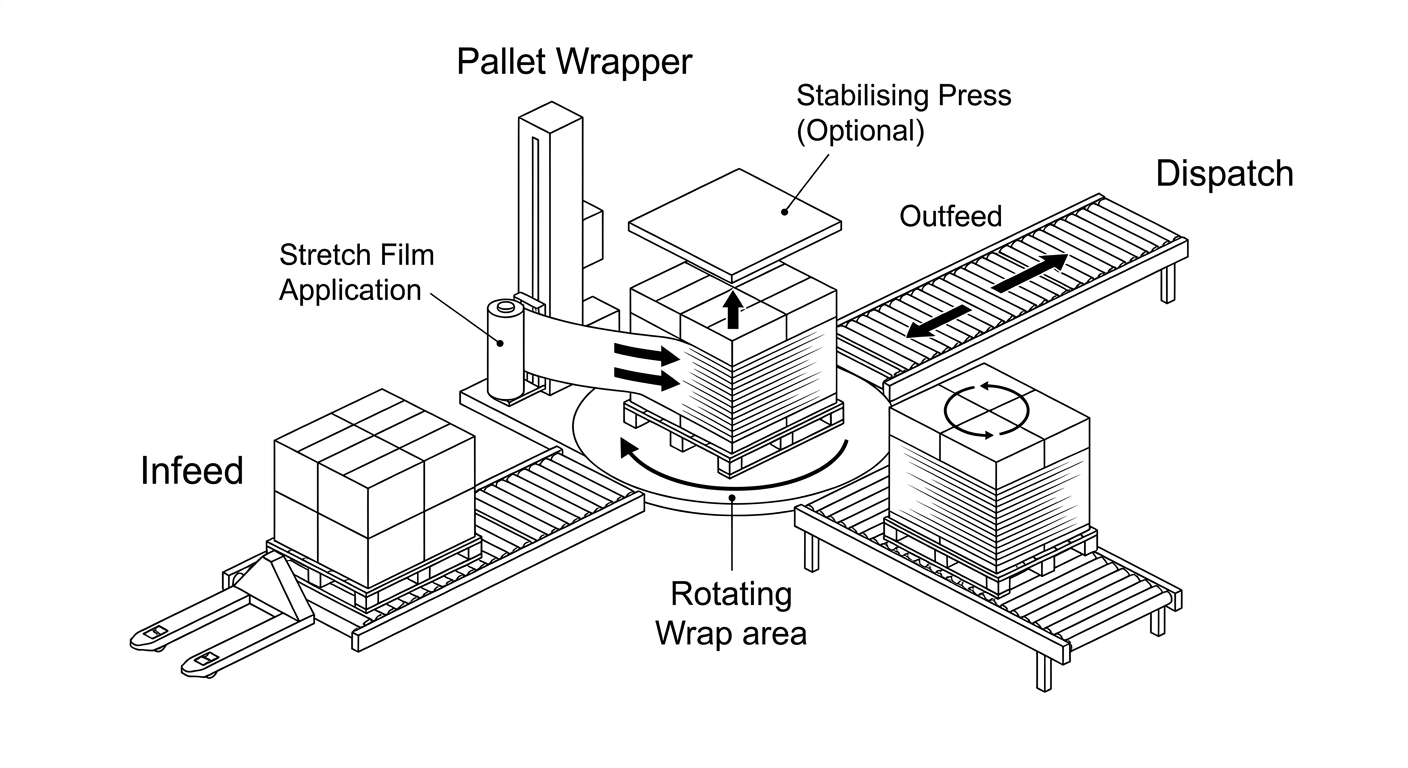
The operating environment should be one of the first considerations. A warehouse pallet wrapper may operate as a standalone station where forklifts or pallet jacks deliver loads for wrapping. Here, footprint, operator access, pallet dimensions and load height are important considerations.
A pallet wrapper for distribution centres may need to accommodate higher volumes and multiple shifts, making repeatability and uptime particularly important. A pallet wrapper for 3PL warehouses also needs flexibility because pallet sizes, load profiles and customer requirements can change regularly.
For logistics operations, consider how the wrapper fits into the movement of goods from receiving and packing through to outbound dispatch.
Choose by Load Behaviour and Stability
The load itself should guide machine selection. Stable, uniformly stacked pallets can generally be rotated on a turntable-style wrapper without compromising the load.
Mixed cartons, tall or uneven stacks, fragile products and unstable loads may require additional control. Important considerations include:
- Film tension and containment force
- Load height and weight
- Pallet stacking consistency
- Pre-stretch requirements
- Top or stabilising press requirements
Where rotating the pallet could compromise stability, a rotary arm system allows the load to remain stationary while the wrapping mechanism moves around it.
Decide Between Semi-Automatic and Automatic Wrapping
What is the difference between a semi-automatic pallet wrapper and an automatic pallet wrapper? The main consideration is the amount of operator involvement required.
A semi-automatic system suits moderate-volume environments where operators can load pallets, initiate the wrapping cycle and remove completed loads. An automatic system reduces operator involvement and suits higher throughput, multiple shifts, and integrated production environments.
Goldpack Packaging supplies manual, semi-automatic and fully automatic solutions. Select based on actual operational requirements, not automation level alone.
Check Throughput, Integration and Line Fit
Assess throughput based on the number of pallets processed per hour or shift. A standalone wrapper may be sufficient when forklifts feed pallets to the machine, and volumes remain manageable.
Higher-throughput production environments may benefit from conveyorised or inline systems that allow pallets to move directly from palletising to wrapping and onward to storage or dispatch.
Features such as automatic height detection, programmable wrapping cycles, controlled pre-stretch, film cutting and film welding can further reduce operator input and maintain consistent performance.
Build the ROI Case Before Requesting a Quote
When comparing a pallet wrapper for sale, purchase price is only one part of the total cost. Decision-makers should also consider:
- Film consumption and potential waste
- Operator time and labour costs
- Rewrapping requirements
Product damage and rejected pallets
- Maintenance and downtime
- Spare parts availability
- Technical and after-sales support
Controlled film pre-stretch can help optimise film consumption while maintaining the required containment force. Automation features such as film cutting and welding can further reduce manual steps.
When should a business request an automatic pallet wrapper quote? When growing volumes, labour requirements, wrapping inconsistencies, film waste, or end-of-line bottlenecks indicate the current process no longer delivers the required efficiency.
| Machine Type | Best Fit | When Not to Choose It |
|---|---|---|
| Semi-automatic turntable | Moderate warehouse volumes, stable pallets and operator-led wrapping. | High-speed lines or unstable loads. |
| Automatic turntable | Repeatable pallet profiles, higher volumes and reduced operator input. | Pallets that cannot rotate safely. |
| Rotary arm or inline system | Unstable loads, conveyor flow and high-throughput production. | Low-volume sites where standalone wrapping is enough. |